
Coming off GamStop, the official route
This page sets out the one route that ends a GamStop self-exclusion and the reasons the scheme is designed the way it is. It walks the official steps in order, covers the twenty-four hour cool-off and the seven-year auto-extension, warns against every third-party removal service that continues to advertise a shortcut, and adds a payments-side layer on how the gambling switch on a UK current-account card can hold the wait steady when the moment of urge lands. The reader who has arrived here on the last day of a five-year period will find the same page as the reader on the first day of a six-month one.
Why this page exists and what it will not do
This page exists because the topic of coming off GamStop is the single most misdescribed part of the wider non-GamStop conversation, and because the misdescription costs readers real money and real safety. Search a phrase like remove GamStop early and the top of the results page will contain services promising to lift a live self-exclusion within twenty-four hours in exchange for a fee that runs from three figures upward. Those services do not deliver what they promise. What they deliver is a receipt for a fee, an account opened at an offshore operator that will match the register on any UKGC-licensed platform anyway, and, in a fair number of the cases the industry sees, a chargeback or an account closure a few weeks later when the register match returns positive at a compliance sweep. The purpose of this page is to sit at the top of an honest reader's decision process before that route is priced against.
The page will not describe a workaround. It will not name any third-party service by name, because naming those services is itself part of the marketing they rely on. It will not treat the twenty-four hour cool-off as a bureaucratic hurdle, because the cool-off is a safety layer designed against the same behavioural evidence that shapes crisis-line waiting periods elsewhere in UK public-health practice. And it will not treat the seven-year auto-extension as a punishment for inaction, because the extension is a feature designed against the population that most needs the scheme to keep working when no one is available to reset it. If the reader is on this page in the last two weeks of a period, the second half of the page is for them. If the reader is on this page in the first two weeks, the first half is.
02The only route that works, in six steps
The one route that ends a GamStop self-exclusion is a sequence of six steps held by the National Online Self-Exclusion Scheme. Step one is to allow the period to run to its scheduled expiry; the minimum is six months, one year or five years, and every day of the chosen period runs to its end without any option to accelerate. Step two is to wait through the twenty-four hour cool-off that begins at expiry and applies before any UKGC-licensed remote operator will complete a successful account opening. Step three is to log in to the personal GamStop account portal at gamstop.co.uk after the cool-off has passed and confirm the intention to end the exclusion; without that positive step, the seven-year auto-extension binds the account against every UKGC-licensed remote operator. Step four is to complete any operator-side identity re-verification requested at the next account opening, which is now, under the 2023 White Paper follow-through, more likely to include a financial-risk element than it was two years ago.
Step five is to review the money-management position before returning to any account, because the moment of expiry is the moment of highest risk of an immediate return to pre-period spending patterns. This means checking the direct-debit and standing-order list, confirming the salary credit is landing where it was, enabling the gambling switch on the current-account card at HSBC, Monzo, Starling, Lloyds or Barclays as an authorisation-layer safety measure, and setting an in-app spending alert well below the value the account has ever carried before. Step six is to open the first account, if the decision has been taken to open one, and to hold to a self-imposed deposit limit for the first thirty days that is meaningfully below the pre-period trend. The scheme is designed to protect the moment of urge; the money-management strand is designed to protect the moment of expiry, and both are needed together for the route to hold.
A closer look
Between steps three and four, a registered player who reaches this point and reconsiders can enrol again for another period through the same portal without needing to speak to any operator. That is worth stating plainly because most readers who reach the end of a period and are unsure about returning are not aware that the portal itself offers a one-click re-enrolment. Re-enrolling is not a failure; it is the scheme working as designed. Anyone who has held to a five-year period and is not certain on the day of expiry sits inside the group that the scheme's original design consultation identified as the group most likely to benefit from a second period. The mere fact of re-enrolment leaves no operator visibility and does not carry any downstream consequence for the account holder's credit, tax or immigration position.
03Why the minimum period cannot be shortened
The impossibility of shortening a live GamStop period is the piece of the scheme design that carries the most weight and receives the least accurate explanation online. The technical position is that the register holds three fields on the length of a live record: the enrolment timestamp, the end timestamp calculated from the period selected at enrolment, and the current status. No operator, no third-party service, no bank, no regulator and no legal action can change the end timestamp on a live record. The register does not expose an early-end field to any external caller, and the scheme's internal operations do not include a shorten-live-record function for any user or administrator. This is a design choice, not an oversight, and it is the reason the scheme has held for the population it was written for.
The design choice sits on two evidence bases. The first is behavioural: self-exclusion works when the period runs long enough to span more than one urge cycle, and shorter is less effective. The second is systemic: any early-end mechanism that existed would be pressed on hardest at the moment of urge, which is precisely the moment the register is designed to hold across. A scheme that admits an emergency shortening route is not a scheme; it is a delay. GamStop's own published guidance sets the position out in the same terms, and the UK Gambling Commission's supervision of UKGC-licensed operators includes a compliance test that operators enforce the register in this shape. The reader who arrives here having found a service claiming otherwise has arrived at the piece of misdescription this page is designed to correct.
04The twenty-four hour cool-off in detail
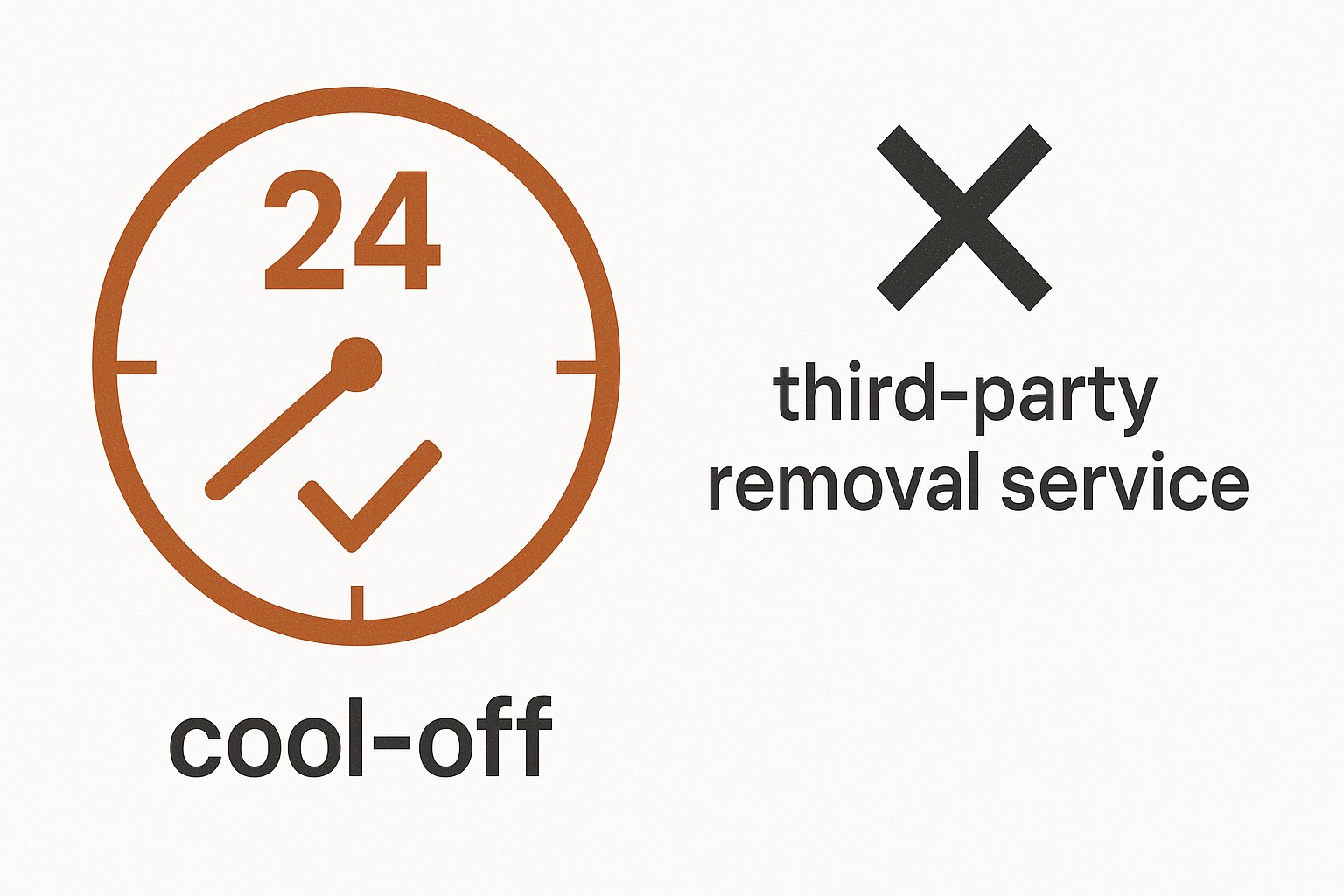
The twenty-four hour cool-off runs from the expiry timestamp of the record to the point at which a UKGC-licensed remote operator will complete a successful account opening. During the cool-off the register still returns a match against any account-opening attempt at a UKGC-licensed operator, and the operator's own compliance layer holds the application. The cool-off does not require the registered player to do anything to activate it, and it cannot be waived by the player, by the operator, by GamStop, by the UKGC or by any third party. The window is fixed and it exists to sit between the mechanical end of the exclusion and the first live account attempt, in the same way that the scheme itself sits between an at-risk player and a live cashier.
Twenty-four hours is a shorter window than most readers expect and it has a specific behavioural design. It is long enough to survive the immediate urge that follows the calendar date of expiry and short enough not to feel arbitrary to a reader who has held a five-year period to its end. It is also long enough to allow the money-management steps set out in section two of this page to be completed without the reader feeling that the wait has already run out. The gambling switch on the current-account card sits well inside the cool-off window as a payment-side safety layer, and the seven-year auto-extension sits at the other end of the window as the default outcome for a player who takes no positive step. The design is not a trap; it is a layered set of safety valves, each of which does a different job.
Key points
- A live GamStop period runs to its scheduled end and cannot be shortened by any route
- A twenty-four hour cool-off follows expiry before any UKGC-licensed account opens
- Doing nothing after expiry enrols the player in a seven-year auto-extension
- The gambling switch on HSBC, Monzo, Starling, Lloyds and Barclays cards holds through the wait
The seven-year auto-extension explained
The seven-year auto-extension is the piece of the scheme that most surprises readers who have not previously interacted with the portal. If a registered player takes no positive step after expiry to end the exclusion, the record remains active against every UKGC-licensed remote operator for a further seven years. The extension is triggered by inaction rather than by any positive step from the player, and it can be reversed only by contacting GamStop through the account portal after the cool-off has passed. The design is deliberate. The population the scheme is written for includes people who signed up in a moment of clarity and then, for reasons ranging from moving house to hospital admission to unrelated crisis, did not return to the portal on the day of expiry. For that population, the default should not be a live account opening on day one; the default should be an extension that holds until a positive step is taken.
The extension has a second use that is less often described. A player who is unsure at expiry whether to end the exclusion or to keep it in place can simply do nothing and let the extension carry the position forward. That option is not a failure of the scheme; it is a passive continuation of the exclusion. The extension can be ended at any point during the seven years by logging in to the account portal and confirming the intention to end the exclusion, which then runs the same twenty-four hour cool-off before a UKGC-licensed account opens. Reading the extension as a punishment for inaction misses the point of its design. It is the safe default, and for a proportion of the registered population it is the outcome that the scheme's original consultation identified as the most likely to be protective.
From the payments-side of the topic, the extension has a practical corollary. A registered player under an active auto-extension can maintain the gambling switch on the current-account card at HSBC, Monzo, Starling, Lloyds or Barclays as a parallel safety layer without any need to reconfigure it at any calendar point. The switch remains on until the customer toggles it off, the toggle-off action carries its own cool-off, and the two layers hold together. That parallel design is one of the reasons the extension appears in the reviewer's notes on this site as a payments-adjacent control rather than as a purely scheme-side one, and it is one of the reasons a reader who has settled into an extended position is unlikely to notice friction on the current-account side of their finances.
A closer look
The seven-year auto-extension binds against UKGC-licensed remote operators only. It does not bind offshore operators, because offshore operators sit outside UKGC remit and are not integrated into the register. That factual point is not a workaround and is not a route around the scheme; it is a description of the boundary of the scheme's reach. A player under an auto-extension who reaches an offshore operator will not encounter a GamStop match, but will encounter every other layer of consumer-protection loss set out on the risks chapter of this site, and the payments-side layer set out on the payments chapter above. The extension is a protective boundary against the environment the scheme is designed to protect against; it is not a promise that all environments are covered.
06Third-party removal services, why they are a scam
Third-party removal services continue to advertise a shortcut to ending a live GamStop self-exclusion, and every route those services describe either fails at the technical hand-off between the register and a UKGC-licensed operator or exposes the customer to reversed transactions and account closures. The register does not expose an early-end field to any external caller, so any service that claims to end a live record is describing an outcome the scheme does not support. What those services usually do is one of two things. Either they open an account at an offshore operator whose site the player could have reached without paying a fee, at which point the payment is a fee for nothing more than a signposting service, or they attempt to route an application through a UKGC-licensed operator using minor differences in email address or postcode, which fails on the operator's compliance sweep and results in the account being closed with any winnings withheld.
GamStop itself has published a warning against removal services, and the UKGC has enforced against operators that have facilitated evasion of the register, including through cease-and-desist notices and remote-operating-licence conditions. The consumer position on a removal-services payment is weak. A card chargeback against a fee paid for a service that has been provided in name only is often defended by the acquirer on the basis that the service was described and delivered, even if the delivered service did not achieve what the marketing promised. That leaves the reader with a paid-for fee, no functional route to gambling at a UKGC-licensed site, and, where the third party has opened an offshore account on the reader's behalf, a live account at an operator the reader has not chosen.
Harm-reduction alternatives while you wait
The last two weeks of a GamStop period are the highest-risk window for an immediate return to pre-period spending, and the harm-reduction layer that sits alongside the wait is worth building through in the week before the calendar date of expiry rather than on the day itself. On the payments side, enabling the gambling switch on the current-account card at HSBC, Monzo, Starling, Lloyds or Barclays holds the payment-side layer in place through the cool-off and for as long as the switch remains on afterward. Setting a spending alert on the account at a value below the account's pre-period trend produces an in-app notification the reader controls, rather than one the bank's compliance system controls. Reviewing the direct-debit and standing-order list closes off the small monthly gambling adjacencies that can drift below the attention line during the exclusion.
On the behavioural side, a call to the GamCare helpline on 0808 8020 133 before the expiry date sits at the front of the harm-reduction routes. The call is free, twenty-four hours, and confidential. The advisor can talk through the reader's plans for the moment of expiry, discuss whether re-enrolment on the day is a route that fits, signpost into the National Gambling Treatment Service if appropriate, and set the reader up with a follow-up call or NetLine web-chat later in the same week. On the money-management side, a conversation with StepChange, National Debtline or the Debt Advice Foundation is worth having before expiry rather than after, because credit lines are easier to restructure while the account is not carrying new gambling debits. The wait is not a passive window; it is a preparation window, and it is what makes the scheme's design work as intended.
08How to call GamCare before you decide
Calling GamCare is easier than most readers imagine. The number is 0808 8020 133, it is free from any UK phone including mobile and landline, it runs twenty-four hours a day, seven days a week, and it does not close on public holidays. The advisor answers within a small number of rings, does not ask for a name, does not ask for an account with GamCare, does not require prior contact with the NHS or any other service, and does not judge. The first minute of the call sets the shape of the conversation; the advisor asks what has brought the caller to the phone that day, and the caller answers in whatever level of detail they are comfortable with. A caller can end the conversation with nothing more than a listened-to conversation and a written note of what to try in the next twenty-four hours, and a caller can end the conversation with an onward referral into face-to-face treatment through the National Gambling Treatment Service.
The value of calling before deciding whether to end an exclusion is that the conversation clarifies the decision without pushing it. The advisor does not tell the caller what to do about the expiry date; the advisor helps the caller think through what the previous period has changed about their position and what the next period would look like if the exclusion were to continue. That structured conversation is a resource that most readers do not know they have access to, and it is designed exactly for the population that reaches the end of a period unsure of the next step. If the phone is not the right channel, GamCare also runs the NetLine web-chat and an email route through the same organisation, and BeGambleAware maintains a directory of local services alongside. The number is not a marketing line; it is a public-information line, and it is repeated here for the same reason it appears at the foot of every content page on this site.
A last practical note on timing. Most readers who reach this page during a live period do so within the final four weeks of the period, and that is the window in which the harm-reduction and money-management preparation set out in section seven produces the greatest protective effect. Calling GamCare during that window is worth doing regardless of whether the reader has already decided on the direction they want to take at expiry. The advisor can hold the conversation for a caller who is planning to re-enrol, for a caller who is planning to end the exclusion, and for a caller who has not yet decided which of the two applies to them. The line is designed to hold the range, and the caller does not need to have reached a conclusion before dialling the number.
Read next
- GamStop explained, the scheme, the periods, the checks
- The legal position for UK players outside GamStop
- The risks, explained without the marketing
- Payments and checks, banks, cards, crypto, KYC
- Getting support, helplines, clinics, family, money
Sources and verification
Verified against GamStop published scheme guidance and UK Gambling Commission supervisory material at gamblingcommission.gov.uk. Last checked 5 August 2026.
Frequently asked questions
Can I shorten a GamStop self-exclusion once it is active
No. Once an exclusion is set to six months, one year or five years it runs to expiry and cannot be shortened by the registered player, by any operator, by any third-party service, and no technical route inside the register supports doing so. This is deliberate design under the National Online Self-Exclusion Scheme. Any provider claiming to shorten a live exclusion is describing an outcome the scheme does not support.
What is the twenty-four hour cool-off after expiry
At the end of a GamStop period, the record moves to expired but a twenty-four hour cool-off period runs before a registered player can successfully open an account at a UKGC-licensed remote operator. The cool-off begins at the expiry timestamp and does not require the player to do anything to activate it. If no action is taken during the cool-off or thereafter, the account remains inaccessible under the seven-year auto-extension rule.
What happens if I do nothing after my GamStop period ends
If a registered player takes no action after expiry, GamStop applies a seven-year auto-extension against every UKGC-licensed remote operator for the full period. The extension is triggered by inaction rather than by any positive step from the player, and it can only be ended by contacting GamStop directly through the account portal after the expiry has passed.
Do third-party GamStop removal services work
No. Every route those services describe either fails at the technical hand-off between the register and a UKGC-licensed operator or exposes the customer to reversed transactions and account closures. GamStop itself has published a warning against removal services. No provider has authority to remove a record from the register outside the expiry-and-opt-back-in flow held on the player's own GamStop account portal.
Can a bank card block help me get through the cool-off
Yes. Enabling the gambling switch on the current-account card at HSBC, Monzo, Starling, Lloyds or Barclays returns a decline at authorisation for any merchant coded to MCC 7995, whether that merchant sits inside or outside UKGC remit. Using the switch during the cool-off, and holding it on for at least a few days after, adds a payment-side layer to the scheme-side wait and reduces the risk of an immediate return to pre-period spending.
Talk to someone today
The National Gambling Helpline is free, confidential and open 24 hours a day, seven days a week.