
GamStop explained, the scheme, the periods, the checks
GamStop is the single-view self-exclusion register that every UKGC-licensed remote operator has to query at the point of account opening. This chapter sets out how the register works, why the three period lengths of six months, one year and five years are structured the way they are, what a UK bank's card gambling switch adds on top of the operator hand-off, and how the twenty-four hour post-expiry cool-off and the seven-year auto-extension sit inside the wider payments-and-compliance picture.
What GamStop is, plainly
GamStop is the National Online Self-Exclusion Scheme, run by the National Online Self-Exclusion Scheme Limited under the oversight of the UK Gambling Commission. Written in payments language, it is a shared block-list held at scheme level and queried by every remote operator that holds a UKGC licence, on every attempted account opening and on every attempted login. The register does not sit inside any single operator's stack. It sits between the applicant and the operator's onboarding flow, in the same architectural place that a fraud consortium file sits between a card issuer and its own risk engine. That placement is the reason the scheme has held for the population it was designed for. A single operator's self-exclusion list can be walked around by opening an account at a second operator. A shared register queried by all of them at the same hand-off point cannot.
From a fintech-compliance angle, the plain fact worth stating first is that GamStop is not a bank block. It does not sit inside a UK current-account provider, it does not talk to Visa or Mastercard, and it does not decline a card at authorisation. The card gambling switch on a HSBC, Monzo, Starling, Lloyds or Barclays account is a separate control at a separate layer, and the two work well together precisely because they do not overlap. GamStop stops the operator opening an account or letting the registered player log back into one. The bank switch stops the card debit reaching a gambling merchant category code, regardless of whether that merchant is UKGC-licensed or not. A reader who understands the difference between the two layers is a reader who can then judge, honestly, where a specific offshore transaction would break through and where it would not.
02The three periods, and what each commits you to
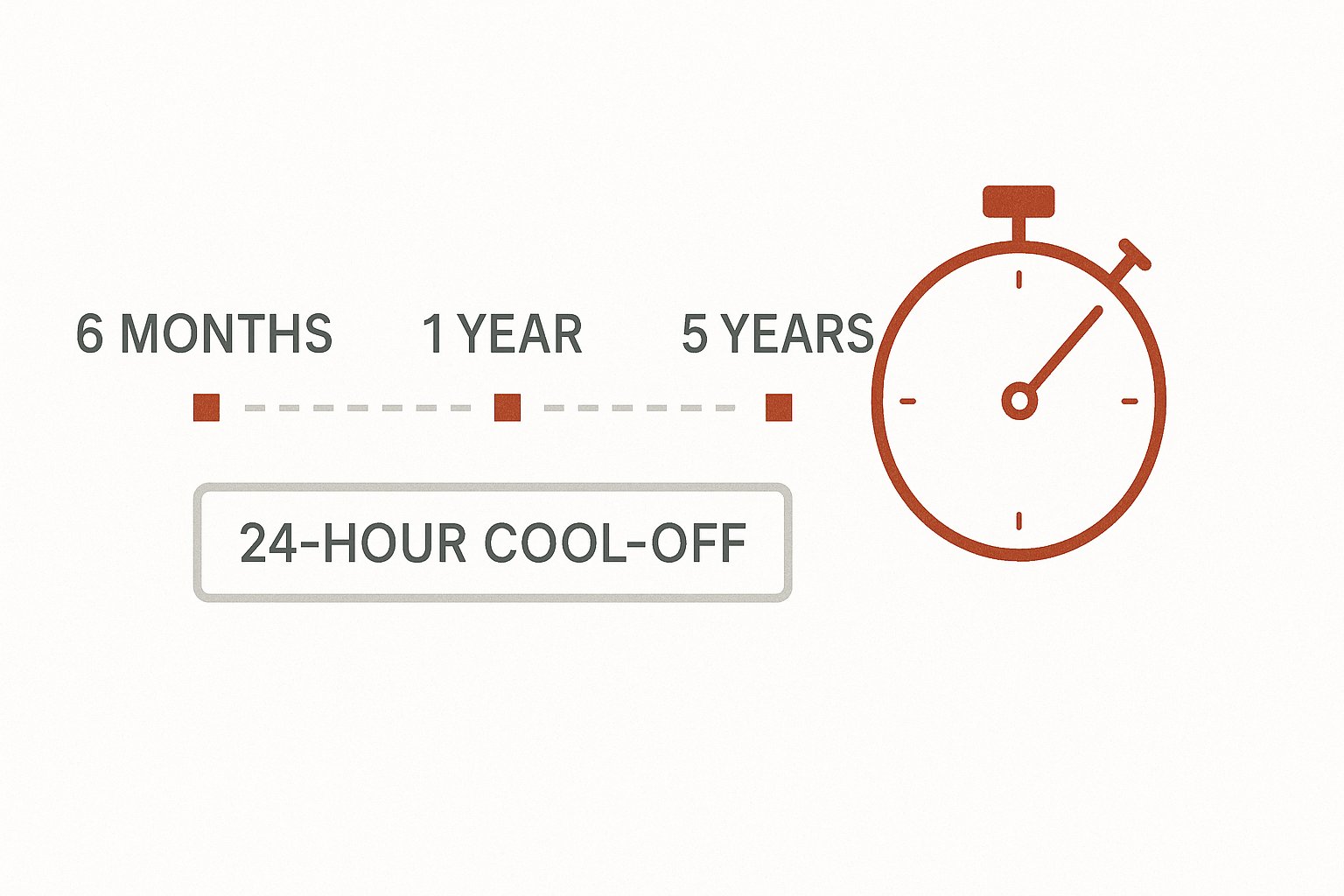
The scheme offers three period lengths and no others. The player chooses six months, one year or five years at sign-up, and once the period is active it cannot be shortened by any route. No operator can shorten it, no third-party service can shorten it, GamStop itself will not shorten it on request, and the scheme has published a plain statement to that effect on its own site. This is not a bureaucratic feature. It is a design choice built on the same clinical evidence that shapes waiting periods around firearm purchases in some jurisdictions and around crisis-line callback windows in mental-health services. The shortest period on the register, six months, sits above the median urge-and-craving cycle documented in gambling-disorder research, which is the reason the shortest period is not shorter.
Choice of period is one of the moments where payments discipline and clinical discipline pull in the same direction. A player who has been quietly loading four-figure sums onto a UK-issued card into offshore acquirers for six months is not a player who will be well served by a six-month period. The compliance-side observation is that the five-year option exists because five years is the length at which the recorded relapse curve for gambling disorder flattens materially against shorter interventions. That is not a marketing claim. It is a design point rooted in the same public-health evidence base that GamCare cites in its own materials, and it is the reason a UK bank's transaction-monitoring team, looking at a customer who has been offered the option and taken the shorter period, will often refer the account for an internal review anyway.
A closer look
The commit that each period represents is the same commit at a technical level. It is a record on the register, keyed to the applicant's identifier set, with an expiry timestamp and a status that will move to expired at that timestamp unless the applicant actively opts back in. A one-year period is a one-year lock at the same fields the six-month period is a six-month lock at. The difference is not in the mechanics but in the length of the window that sits between the moment of sign-up and the moment of any legitimate reengagement, and in the length of the window across which the auto-extension will trigger if the player does nothing. That practical difference is why the choice of period is one of the few points on the sign-up flow where GamStop's own materials nudge the player, quietly, towards the longer option.
03How the block reaches every UKGC-licensed site
The block reaches every UKGC-licensed remote operator because the licence itself requires it. Under the UKGC's social-responsibility code provision on self-exclusion, an operator that offers remote gambling to Great Britain has to be a participant in a national multi-operator self-exclusion scheme, and GamStop is that scheme. Compliance with that provision is not a matter of an operator's own preference. It is a licence condition, audited by the regulator, and non-participation is not open to a UKGC-licensed remote operator that wants to keep the licence. The consequence is that every UKGC-licensed remote site is on the same shared register, and the applicant's identifier set is checked at the same hand-off point regardless of which site the applicant walked into.
The hand-off itself is a machine-to-machine query. The operator's onboarding form collects the identifier set, hashes what needs hashing, sends the query to the register and receives a match, partial-match or no-match response. On a positive match the account cannot be opened. On a partial match, typically caused by a variant spelling of a name or a household postcode mismatch, the operator has to run a manual review before proceeding, and the audit trail of that review is one of the artefacts the UKGC will ask to see during a compliance visit. A registered player who tries to open an account under a variant of their own name will not slip past the check without triggering that manual review. A registered player who tries to open an account under someone else's identifiers has left the space of self-exclusion and entered the space of identity fraud, which is a different offence and a different conversation.
04What happens when your period ends
The period ends at the timestamp recorded when it was set, and the register moves that record to an expired status at that timestamp. Nothing else changes automatically at that moment. The player is not signed back in anywhere, no operator account is unlocked, and no payment rail suddenly resumes. The player who wants to open a UKGC-licensed account after expiry has to take an action to do so, and that action passes through the GamStop account portal rather than through the operator's onboarding page. The design point is to keep the moment of reengagement inside the scheme's own environment rather than inside a cashier flow that has commercial reasons to move it along quickly.
Payments-side, the moment of expiry is also the moment at which the transaction-monitoring rules calibrated on a self-excluded population stop applying to the account. A UK bank that has been treating gambling debits from the customer with the level of scrutiny it applies to a self-excluded player will not, in general, be aware of the exact moment of expiry. It will, however, be aware that the pattern of debits from the account has shifted, and the compliance-side observation is that the first month after expiry is the month in which any material change in card-side behaviour is most likely to trigger an internal review. That is not a punishment. It is a reflection of the same evidence base that shaped the twenty-four hour cool-off, applied by a different institution to a slightly wider window.
Key points
- GamStop stops the UKGC-licensed operator, not the UK bank card, and the two layers add up rather than duplicate
- Minimum period cannot be shortened once active, by any route, technical or otherwise
- Twenty-four hour cool-off runs from the moment of expiry to the first successful login at a UKGC-licensed site
- Auto-extension for a further seven years applies wherever the player does nothing after expiry
- Card gambling switch on HSBC, Monzo, Starling, Lloyds and Barclays sits alongside the register and does a complementary job
The twenty-four hour cool-off explained
The twenty-four hour cool-off is the window that runs from the moment a period is treated as expired to the first successful account opening or login at a UKGC-licensed operator. It is not a bureaucratic delay. It is a friction period, designed on the same evidence base that gives crisis-line services their twenty-four to seventy-two hour callback window, and it is designed to sit between the moment of decision and the moment of first live cashier interaction so that a decision made under pressure has room to be revisited before any money moves. A cool-off compressed into minutes or removed entirely would defeat that design point, and the scheme has been explicit that it is not open to any route that shortens it.
From a fintech-compliance angle, the cool-off is worth reading alongside the cool-offs that sit inside the bank card gambling switches. HSBC, Monzo, Starling, Lloyds and Barclays each apply their own cool-off between the moment the customer toggles the gambling switch to the off position and the moment the next gambling authorisation would actually clear. Those cool-offs vary in length between around twenty-four and seventy-two hours across the five providers and are the reason a customer who toggles the switch in the app and then immediately tries to load a card at a gambling cashier is going to see a decline for a period afterwards. GamStop's own twenty-four hour post-expiry cool-off and the bank switches' own cool-offs are separate features on separate systems, but they share the same behavioural logic, and a compliance-side reader will notice how consistently the same window keeps appearing at different points across the harm-reduction stack.
A closer look
Inside that window the register still returns a positive match against the identifier set, which is the reason a UKGC-licensed operator whose flow does not respect the cool-off will still see the account-opening attempt rejected. The cool-off is not an operator courtesy, it is a scheme-side status held on the register itself, and the flag against the record is what causes the operator's onboarding query to return in the way it does. That layer of the design matters because it removes the possibility that a single operator, motivated by the commercial value of a returning player, could shorten the cool-off inside its own onboarding page. It cannot, because the register does not let it.
06The seven-year auto-extension nobody warns you about
The seven-year auto-extension is the scheme's default state after expiry, and it is the feature of the scheme that is most consistently missed by players who signed up under stress and did not read the confirmation email closely. The rule is straightforward. If a registered player takes no action to opt back in through the GamStop account portal after the period expires, the exclusion continues for a further seven years against every UKGC-licensed remote operator. It does not need any further sign-up on the player's part. Inaction is the trigger, and inaction is the safe default in the same behavioural sense that inaction is the safe default on organ-donation opt-out schemes in the health-policy literature.
The seven-year figure is not arbitrary. It sits at roughly the length across which the recorded relapse curve for gambling disorder flattens against shorter interventions in the same public-health evidence base that shapes the choice of period lengths and the length of the cool-off. A payments-compliance reader is going to see the same figure appear inside internal AML risk models for high-risk merchant categories at UK banks, where a customer who has been on a heightened-monitoring flag for a materially long window tends to have the flag reviewed rather than removed on any single positive month. The scheme's seven-year default and the bank's seven-year monitoring tail are not the same feature, but they are not independent either. They come from the same underlying view of the population.
GamStop and the wider harm-reduction picture
GamStop does not sit on its own. It sits inside a wider harm-reduction picture that includes the National Gambling Helpline on 0808 8020 133 run by GamCare, the treatment routes offered through the National Gambling Treatment Service, the awareness and education layer funded by GambleAware and delivered under the BeGambleAware banner, and the money-management tools that UK current-account providers have progressively added to their banking apps. Each of these controls addresses a different part of the same behavioural cycle. The register removes the option of live-cashier access at the operator. The bank switch removes the option of card debit to a gambling merchant. The helpline supports the player through the moment. The treatment routes address the underlying condition. The money-management tools address the household budget in which the moment plays out.
The compliance-side reading of the wider picture is that a self-exclusion registered on the scheme is one of the strongest single interventions available inside the UK harm-reduction stack, and its strength comes from the impossibility of shortening it and the persistence of the auto-extension after it. Nothing about that reading is diminished by the presence of operators outside UKGC remit. If anything, the wider harm-reduction picture is where a fintech-compliance reader is most likely to see the payments-side controls doing their heaviest work, because the register does not, on its own, catch the offshore transaction. The bank switch does, and the register and the switch together are the pair of controls that most cleanly cover both sides of the boundary that the scheme's own remit ends at.
08Common misreadings of the scheme
The commonest misreading of the scheme is that it is a way to block a payment. It is not. It is a way to block an operator account. The distinction matters because a player who registers with the expectation that the register will decline a card at the merchant will find, sooner or later, that a Curaçao-licensed operator's cashier is coded outside the reach of a register that never sat at the card layer in the first place. The register does what it was designed to do, at the operator layer. The layer that decides whether a card debit clears is a different layer entirely and is where the bank switch sits. A reader who conflates the two ends up disappointed with the scheme for not doing something that is not, and never was, part of its design.
The second common misreading is that the scheme is a punishment. It is not. It is a voluntary, publicly funded harm-reduction control that a player asks for on their own behalf, and every element of its design points at the moment of urge rather than at the moment of registration. The impossibility of shortening the minimum period is not a punishment for asking, it is a design feature that makes the ask meaningful. The twenty-four hour cool-off after expiry is not a punishment for wanting to return, it is a window in which the returning player can revisit the decision under less pressure than at the moment of expiry itself. And the seven-year auto-extension is not a punishment for inaction, it is the safer default across the population the register was written for. Read as a set of design features rather than a set of restrictions, the scheme is easier to work with and harder to walk around, which is what it was designed to be.
Read next
- The legal position for UK players outside GamStop
- The risks, explained without the marketing
- Payments and checks, banks, cards, crypto, KYC
- Coming off GamStop, the official route
- Getting support, helplines, clinics, family, money
Sources and verification
Scheme mechanics, period lengths, the twenty-four hour post-expiry cool-off and the seven-year auto-extension are stated on the scheme operator's public information pages at gamstop.co.uk. Last checked 5 August 2026.
Frequently asked questions
Does GamStop stop a gambling card debit at my UK bank, or only at the operator?
GamStop itself stops the operator, not the bank. The register sits at the account-opening and login layer of every UKGC-licensed remote operator, so the block bites when the operator queries the scheme with the customer's identifier. The card gambling switch offered by HSBC, Monzo, Starling, Lloyds and Barclays is a separate control that sits at the authorisation layer of the card. The two do very different jobs, and a self-excluded player who wants a belt-and-braces position typically has both engaged at the same time.
Can a UKGC-licensed operator take my deposit while I am registered on GamStop?
No. A UKGC-licensed remote operator has to query the register at account opening and reject any application that returns a positive match on the identifier set held by GamStop. If a payment attempt reaches the cashier at a UKGC-licensed site after a match should have returned, that is a compliance breach on the operator side and it is the operator that is on the hook to the UKGC under the social-responsibility code, not the customer.
How is the GamStop hand-off actually queried by an operator's onboarding flow?
Every UKGC-licensed remote operator queries the register over a machine-readable interface using the identifier set the applicant has supplied, which typically means name, date of birth, postcode, email and mobile. The register returns match, partial match or no match. On a positive match the operator has to reject the application; on a partial match it has to run additional checks before opening the account; and it has to keep an audit trail that its regulator can review during a compliance visit.
If GamStop only stops UKGC-licensed operators, why does it matter for someone whose deposits are already going offshore?
Because the great majority of UK player spend still passes through UKGC-licensed operators, and because the payments-side controls that sit around the scheme, from the card gambling switch to the source-of-funds prompt, are calibrated on the same behavioural evidence that the twenty-four hour cool-off and the seven-year auto-extension were calibrated on. A player who is registered has a full layer of friction at the UKGC-licensed environment, which is the layer where most exposure sits, and can then use the bank-side controls to add friction on the offshore layer.
What happens on the register if I stop responding to GamStop reminders in the run-up to expiry?
Nothing on the register itself. The scheme continues to hold until the moment of expiry recorded when the period was set, and if the player takes no action to opt back in through the GamStop account portal after that moment, the exclusion continues for a further seven years. The reminders are a courtesy. The default is not that the exclusion lapses on expiry; the default is that it extends. That default is designed deliberately to make inaction safer than reengagement.
Talk to someone today
The National Gambling Helpline is free, confidential and open 24 hours a day, seven days a week.